







Editorial Disclosure: Montana Capital Car Title Loans® (NMLS ID 2249848) is a licensed direct lender. This content is informational only and does not offer legal or financial advice. Terms, APRs, and availability may vary by state and borrower qualifications.
Facing eviction is one of the most overwhelming financial situations a person can experience. The fear of losing your home, often with only days to act, can make it hard to think clearly about next steps. That’s exactly why this guide is structured the way it is.
In most situations, free resources are the best first call. Government rental assistance, local nonprofits, and free legal aid may be able to help you without any repayment obligation.
If those options aren’t available or aren’t fast enough, there are emergency eviction loans, and this guide covers both, in the right order.
Quick Summary
- Free resources, including state and local rental assistance and legal aid, are usually the best first step before considering any loan product.
- Emergency eviction loans, including title loans, installment loans, and payday loans, are available for renters with bad credit, but carry high costs and risks.
- Title loans may provide fast funding using your vehicle as collateral, but repossession is a real risk if payments are missed. Terms vary by lender and state.
- High-APR borrowing during a housing crisis can create a debt cycle; calculating the total dollar cost before you sign can prevent a bad situation from becoming worse.
- Understanding your legal rights as a tenant, including the right to a court hearing and the right to dispute improper notices, can buy valuable time even without a loan.
Your First Step: Free Resources Before Borrowing
Before you consider emergency loans to stop eviction, it is worth exploring the free options available to you. Many renters in a housing crisis are not aware of how much help they can access at no cost.
Government Rental Assistance
The federal Emergency Rental Assistance (ERA) program previously distributed funds through state and local agencies to help renters cover past-due rent and utility costs. Federal ERA funding has largely ended, and the Treasury has stated that ERA2 award funds can no longer be used to assist renters.
However, some state and local programs may still have remaining or successor funds available. Use the NLIHC rental assistance finder to locate currently active programs in your area, as availability varies significantly by state and county.
Legal Aid for Eviction Defense
Free legal aid can do more than represent you in court. It can delay or stop an eviction, help negotiate a repayment plan with your landlord, and identify procedural errors in the eviction notice that could affect the outcome of your case.
Many tenants don’t realize that a landlord’s failure to follow proper legal procedure can be raised as a defense. The Legal Services Corporation (LSC) funds legal aid organizations across the country.
211 and Local Nonprofits
If you haven’t already called 211, it is worth doing immediately. Dialing 2-1-1 connects you to a local specialist who can identify rental assistance programs, food banks, emergency shelters, and other crisis resources specific to your area.
Local nonprofits, community action agencies, and organizations also provide emergency rent assistance that does not require repayment.
LIHEAP and Utility Assistance
The Low Income Home Energy Assistance Program (LIHEAP) helps qualifying households cover heating, cooling, and utility costs. Reducing utility expenses can free up available cash that can be redirected toward overdue rent. Contact your state’s LIHEAP office or visit the ACF LIHEAP program page to find your local provider.
Section 8/Housing Choice Vouchers
Housing Choice Vouchers (commonly called Section 8) are a longer-term subsidy program designed to help low-income households afford stable housing.
Wait lists are often long, and this is not an immediate eviction solution. However, if you are not already on a wait list, applying now may benefit your housing situation over the longer term.
When Borrowing May Make Sense
A loan is a tool with real costs attached. Before applying for any emergency eviction loan, it is worth honestly assessing whether borrowing makes sense for your specific situation.
| A loan may be appropriate when: | A loan is likely to make things worse when: |
| ⚪ Free assistance programs are not available in your area. ⚪ The eviction date is imminent (within days), and a court hearing has already been filed. ⚪ The rent shortfall is a specific, fixed amount, not an ongoing monthly gap. ⚪ You have a reliable income stream that will allow you to repay the loan without creating next month’s shortfall. ⚪ You’ve already spoken with your landlord and agreed on a specific repayment amount to avoid further court proceedings. | 🟡 The hardship is ongoing with no clear income recovery in sight. 🟡 You would need multiple loans to stay current on rent. 🟡 You don’t have a vehicle or asset available to secure a title loan. You may need to consider other loan options that can vary in APR. |
If any of the warning signs above apply, return to the free resources section before taking on debt.
Emergency Loan Options Compared
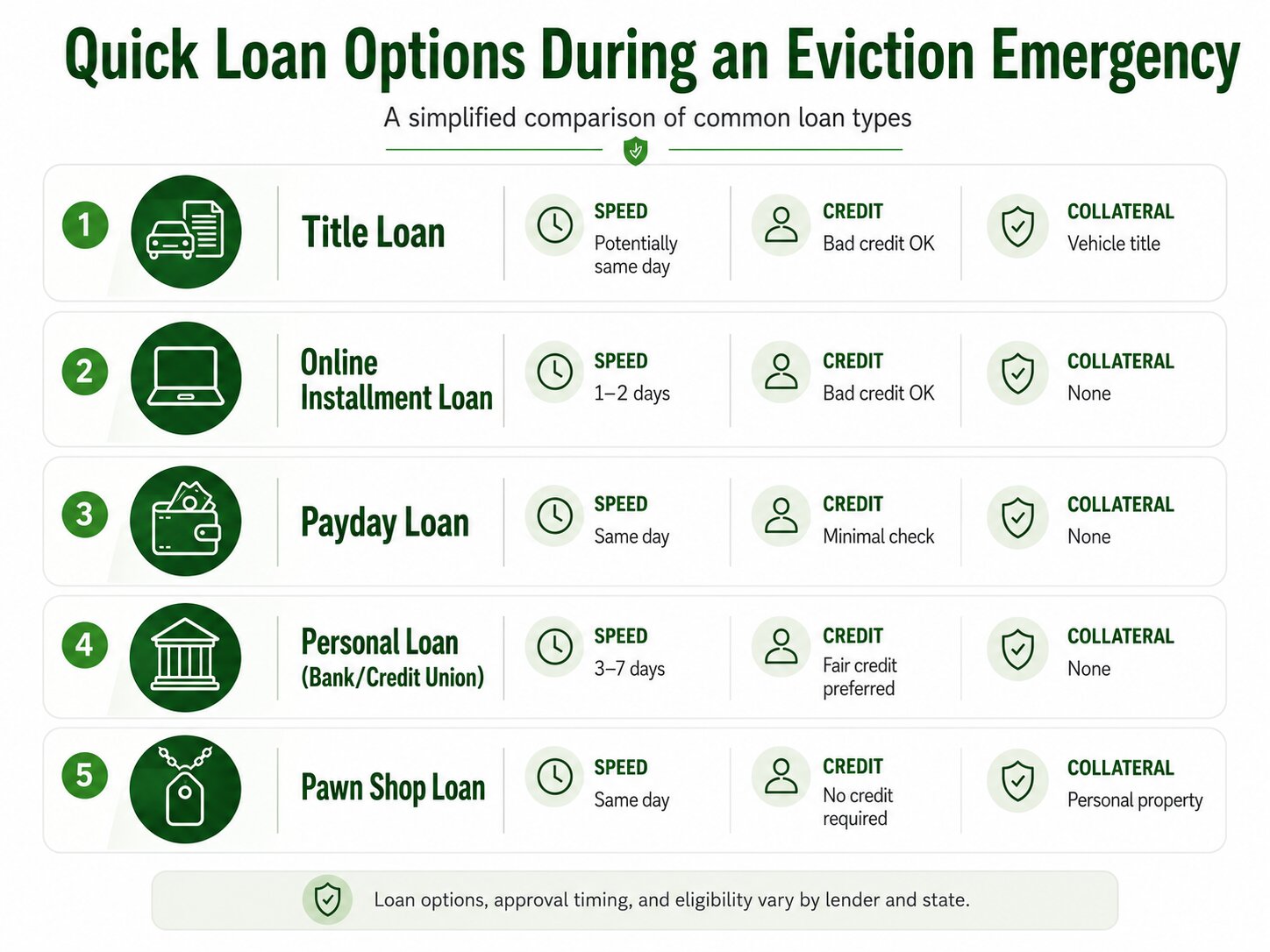
If you’ve determined that borrowing is appropriate for your situation, the table below summarizes the main loan types available to renters facing eviction.
Title Loans
A car title loan uses your vehicle as collateral, though terms and conditions vary by lender and state. You keep driving your car while repaying the loan, and your title is returned once the loan is paid in full.
Many title lenders focus more on vehicle value and income than on credit score, which makes this option accessible to borrowers with damaged credit histories.
Fast funding should also be possible, depending on the lender, timing, and state. Before applying, keep in mind that repossession is a real and serious risk if payments are missed and must be factored into your decision.
Online Installment Loans
Installment loans are repaid in fixed monthly payments over a set term. Unlike payday loans, there is no single balloon payment due on your next payday.
This structure is more manageable for rent-sized amounts. Borrowers with less-than-perfect credit may be able to qualify for some installment loan products, though rates are typically higher than bank loans.
Payday Loans
Payday loans provide fast cash but carry APRs that routinely exceed 300%, with full repayment typically due within two weeks.
For a rent-sized loan, this structure creates a serious risk of a debt trap: if you can’t repay in full on the due date, rollovers or extensions add fees rapidly. Use payday loans only for very small shortfalls where you are certain of repayment on the next pay date.
Personal Loans from Banks or Credit Unions
If you have fair credit and a few days before the eviction deadline, a personal loan from a bank or credit union can offer lower APRs than title or payday loan products.
Some credit unions offer emergency loan programs for members. The tradeoff is time: approval and funding typically take three to seven business days, which may not be workable if the eviction is imminent.
Pawn Shop Loans
You can bring electronics, jewelry, or other valuables to a pawn shop in exchange for a short-term loan. Terms vary widely, fees can be steep, and loan amounts may not be sufficient for a full month’s rent in many markets. This is generally a last-resort option for covering a small gap.
Before signing any loan, verify the lender’s NMLS ID at nmlsconsumeraccess.org to confirm they are licensed to lend in your state.
Using a Title Loan to Stop Eviction
A car title loan is one of the few financing options that may deliver fast funds to a borrower with bad credit. It is worth considering when eviction is days away, and other options have been exhausted. However, it should be treated as a last resort, not a first response.
A title loan may be the right tool when all of these apply:
- Your eviction date is imminent, and free assistance is unavailable or too slow.
- You own a vehicle with sufficient equity, and the car’s value exceeds what you owe on it.
- You have sufficient income to make repayments without creating a secondary financial crisis.
Why Choose a Car Title Loan for Emergency Rent from Montana Capital®?
Fast Access to Funds
When you’re facing an urgent rent payment, timing matters. Montana Capital’s application process is quick and straightforward.
In some cases, you may receive conditional approval the same day, and same-day funding⁷ may be available depending on when you apply, your state, and your bank’s processing times.
Keep Driving Your Vehicle
Selling your car to cover rent can leave you without reliable transportation when you need it most. With a title loan, you can continue using your vehicle while repaying the loan, helping you get to work and manage daily responsibilities as long as you stay current on your payments.
Accessible for Borrowers with Bad Credit
If your credit score is less than perfect, you may still qualify. For most title loans, lenders focus primarily on your vehicle’s equity and your ability to repay rather than your credit score.
Montana Capital® offers title loans, subject to state availability and underwriting, with loan amounts based on your vehicle’s value and applicable state limits.
Potential Risks Of Car Title Loans for Eviction
Title loans carry high APRs, typically up to 175%, depending on your state and loan terms. If you miss payments, your vehicle can be repossessed. This is not a long-term fix for an ongoing income shortfall, and it may not be suitable in every case. It is intended as a bridge to cover a specific, manageable gap when no better option is available.

Risks of Borrowing to Stop Eviction
The Debt Cycle Risk
Borrowing to pay this month’s rent without resolving the underlying income gap often means that loan repayments consume the funds needed for next month’s rent. The cycle can escalate quickly when interest compounds.
The Real Cost of High-APR Borrowing
To understand how much you will need to repay, here are illustrative examples:
At a nominal 120% APR, a $1,000 balance can accrue roughly $100 in interest per month, before fees and depending on the lender’s compounding and repayment structure.
A $1,000 payday loan can also become much more expensive over time, depending on the loan terms and state laws.
Collateral Risk in an Eviction Scenario
The same job loss or income event that caused the eviction can also prevent loan repayment. If you default on a title loan, you risk both losing your home and losing your vehicle. A compounded crisis that is harder to recover from than the original eviction.
A Practical Rule of Thumb
If total monthly loan repayments would take up a large share of your take-home income, the loan may be difficult to sustain. Run this calculation before signing and be honest about what your budget can realistically support.
Before signing any loan, consider a free credit counseling session through the National Foundation for Credit Counseling (NFCC), which can help you evaluate your options in 30–60 minutes.
How Does the Eviction Process Work?

Eviction timelines vary significantly by state. Some states require only three days’ written notice before filing; others require 30 days or more. To know how much time you have, visit HUD’s tenant rights resource for state-specific information.
The typical eviction process follows these stages:
- Written notice from landlord: Your landlord must give you a formal written notice, stating how many days you have to pay the overdue rent or vacate.
- Opportunity to cure: In many states, you have the right to pay all overdue rent during the notice period and stop the eviction.
- Court filing: If you haven’t paid or vacated, the landlord files an unlawful detainer (eviction lawsuit) with the local court. You will typically be served with a summons and given a date to appear.
- Court hearing: Both sides present their case. This is your opportunity to raise defenses, including improper notice, habitability issues, or discrimination.
- Judgment: If the landlord prevails, the court issues a judgment for possession. This does not mean you must leave immediately; there is typically a further notice period before enforcement.
- Writ of possession/lockout: If you remain after the judgment period, the court may issue a writ of possession, and a law enforcement officer carries out the physical lockout.
Final Thoughts
Facing eviction is a crisis, but it is one that many people have navigated with the right combination of resources, knowledge, and timely action. The path forward usually starts with free options: state and local rental assistance, and legal aid. These programs exist specifically for moments like this one.
If free resources aren’t available quickly enough and your eviction date is imminent, emergency eviction loan options, including title loans, may provide fast funds for borrowers with bad credit in some cases.
The key is going in with a clear understanding of the costs:
- Know the full repayment amount
- Confirm the lender is licensed
- Only borrow an amount that your income can support
Don’t face this alone. Contact legal aid in your area, and explore every free option before taking on high-interest debt. If you’ve exhausted those avenues and need fast funding, Montana Capital’s online application is designed to be completed quickly and can get you a decision in many cases, the same day⁷.
Frequently Asked Questions
Are Emergency Eviction Loans a Good Option Compared to Rental Assistance Programs?
In most cases, rental assistance programs are a better first option because they don’t require repayment. Emergency eviction loans, including title loans and installment loans, carry interest costs that can be significant, particularly for borrowers already in financial hardship.
That said, rental assistance programs can take days or weeks to process, and some areas have exhausted available funds. If free assistance isn’t available fast enough and your eviction is imminent, an emergency loan may be the most viable tool within your timeline. Use loans as a last resort rather than a first response.
What Should I Do If I Receive an Eviction Notice?
Read the notice immediately to identify the deadline and the exact overdue amount. Contact your landlord in writing to acknowledge the situation and express your intent to resolve it. Find local rental assistance programs or contact a legal aid organization to review whether the notice was properly issued.
If a loan is necessary, begin the application process right away. Most importantly, do not ignore the notice or miss any court dates, as failure to appear can result in a default judgment against you, depending on your jurisdiction.
Can I Get an Emergency Rent Loan with Bad Credit?
Yes, Montana Capital® offers car title loans that are accessible to borrowers with bad credit. Car title loans primarily focus on vehicle equity rather than credit score, making them one of the more accessible emergency loan options for people with damaged or limited credit histories.
Other loan types include online installment loans and payday loans, which also have minimal credit requirements, though their APRs are substantially higher.
Who Qualifies for Emergency Eviction Loans?
Qualification criteria vary by loan type. For title loans, the primary requirements generally include owning a vehicle with sufficient equity (the car’s value exceeds what you owe on it), having verifiable income, and having a valid government-issued ID.
How Quickly Can I Get an Emergency Eviction Loan?
Speed varies significantly by loan type. Title loans are among the faster options. Montana Capital’s application is designed to be completed quickly, and in some cases, conditional approval and funding may be possible the same day⁷, depending on your state, application timing, and banking processing.
Payday loans can also be funded the same day. Online installment loans typically fund within one to two business days. Personal loans from banks or credit unions generally take three to seven business days.
Can Emergency Eviction Loans Affect My Credit Score?
It depends on the lender and the loan type. Many title lenders and payday lenders do not report to the major credit bureaus for routine repayment, meaning on-time payments may not help build your credit.
Before accepting any loan, ask the lender directly whether they report to the credit bureaus and how delinquencies would be handled.
Can I Use Emergency Eviction Loans for Other Housing-Related Expenses?
Generally, yes. Most emergency loan products, including title loans and installment loans, are personal loans that can be used for any legal purpose. This means the funds can cover past-due rent, court fees associated with an eviction proceeding, moving costs if relocation becomes necessary, or security deposits on a new rental.
Disclaimer: This content is for general informational purposes only and does not constitute legal, financial, or tax advice. Laws and programs vary by state and change over time. Consult a qualified attorney or nonprofit credit counselor for advice about your situation. Product availability, APRs, and terms vary by state and borrower.