






Yes, you can use your car as collateral for a loan. With a car title loan, you can usually continue driving your vehicle while you make payments, even though the lender has a legal claim to the title.
When you take out the loan, the lender places a lien on your car’s title. This means they have the right to repossess the vehicle if you don’t repay the loan as agreed.
Once you’ve paid off the loan in full, the lien is removed, and the title is released back to you. The exact process may vary depending on the lender and your state.
This type of financing is often called a car title loan or auto collateral loan. It may be an option if you own your vehicle outright or have equity in it, need cash quickly, or have difficulty qualifying for a traditional bank loan.
Montana Capital® is a direct lender that offers car title loans from $100 to $50,000 through a fully online application process, with no store visit required.⁴ Depending on your state and individual circumstances, some applicants may need to visit a physical location.
The Title Loan Timeline at a Glance
- You can use your car as collateral for a loan while continuing to drive it. The lender places a lien on your vehicle’s title, which is released after you repay the loan in full.
- Loan amounts are based primarily on your vehicle’s market value and your ability to repay³.
- Title loans carry high interest rates⁶. Rates can reach up to 175% APR depending on the lender and applicable state law, and they are intended for short-term financial needs only.
- If you do not make the required payments, the lender may repossess your vehicle⁵.
What Does Using Your Car as Collateral Mean?
At Montana Capital®, the process begins with an online application. We review your vehicle’s value together with your ability to repay before making a loan offer. If approved, we place a lien on the title while you continue driving your vehicle throughout the loan term.
Even if you use your car as collateral, you do not have to give it up. In most cases, you can continue driving it as usual while making your loan payments.
The Consumer Financial Protection Bureau explains that a lien gives the lender the legal right to repossess the vehicle if the borrower doesn’t repay the loan.
How We Determine Your Loan Amount at Montana Capital®
Many borrowers assume we want to lend the largest amount possible. However, in reality, our priority is approving the loan you can comfortably repay. Hence, in your application, we pay closest attention to both your vehicle’s value and your ability to repay the loan.
Our internal lending data show that from 2025 through mid-2026, about half of the loans we funded were for $3,000 or less, while the typical loan amount was about half of the vehicle’s value. The typical vehicle securing one of our loans was a 10-year-old daily driver worth about $6,000.
That means if your offer is lower than you expected, it isn’t necessarily a reflection of your vehicle. A loan with affordable payments is more likely to be successfully repaid, which benefits both you and us.
How Collateral Loans Work with Montana Capital®: The Step-by-Step Process
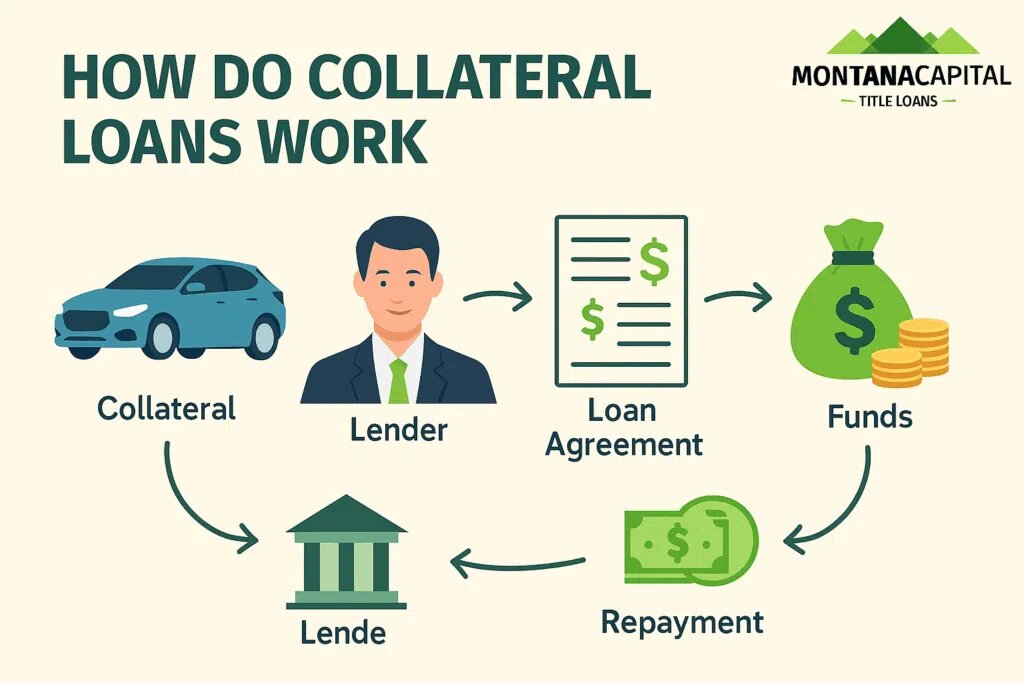
The process for getting a loan using your car as collateral at Montana Capital® begins with a convenient online application. Here is what to expect from start to funding:
- Complete the online application or visit office. Provide basic personal information and details about your vehicle, such as its year, make, model, mileage, and condition.
- Upload the required documents. You’ll typically need a government-issued ID, your vehicle title, proof of income, and photos of your car. In many cases, your documents can be reviewed online, though some applicants may need to visit a physical location.
- Your vehicle is evaluated. We don’t simply lend the maximum percentage of your vehicle’s value. We review your vehicle’s market value alongside your ability to repay so the loan amount is appropriate for your financial situation.
- Review and sign your loan agreement. If you’re approved, you’ll receive a loan offer that includes the loan amount, interest rate, repayment schedule, and other terms. Be sure to read everything carefully before signing.
- A lien is placed on your title. Once you accept the loan, we become the lienholder on your vehicle’s title. You can continue driving your car while you repay the loan.
- Receive your funds. If you’re approved before 2:00 PM PT on a business day, funding may be available the same day⁷, depending on the review process and state requirements.
- Get your title back. After you’ve repaid the loan in full, the lien is removed, and your title is released back to you.
The Federal Trade Commission advises borrowers to understand the full cost of a title loan, including fees, interest, and the consequences of missed payments, before signing any agreement. Defaulting on a secured loan can result in the repossession of your vehicle.
Why Applications Are Sometimes Declined
You may not qualify for a loan if:
- Your vehicle doesn’t have enough equity to support the requested loan amount.
- The vehicle title isn’t in your name, so it can’t be used as collateral.
- You can’t provide verifiable proof of income, which helps us determine your ability to repay the loan.
How to Improve Your Chances
Before you apply:
- Make sure the vehicle title is in your name.
- Have proof of income and a government-issued ID ready.
- Submit clear photos of your vehicle.
- Request a loan amount that fits your budget and ability to repay.
- Apply early in the day if same-day funding⁷ is important.
What Borrowers Often Get Wrong About Car Collateral Loans
Many first-time borrowers have misconceptions about how car collateral loans work. Here are some of the most common ones we hear:
“The lender wants to lend me as much as possible.”
Not necessarily. At Montana Capital®, our goal is to approve a loan that fits both your vehicle’s value and your ability to repay. An affordable loan is more likely to be successfully repaid, which is a better outcome for everyone.
“A newer or more expensive car automatically means I’ll qualify for a larger loan.”
Vehicle value is an important factor, but it isn’t the only one. We also consider your ability to repay the loan, state regulations, and other eligibility requirements. The final loan amount is based on the overall application, not just the vehicle itself.
“Bad credit means I won’t qualify.”
Not always. Unlike many traditional lenders, we don’t rely on a minimum credit score requirement. Instead, we focus primarily on your vehicle’s equity and your demonstrated ability to repay the loan. Past credit challenges may not automatically prevent you from qualifying.
What Vehicles Can You Use as Collateral?

We accept a range of vehicle types as collateral, not just passenger cars. Eligible vehicles may include:
- Cars and trucks, including sedans, SUVs, pickups, and minivans
- Motorcycles of most makes and models with a clear title
- Recreational vehicles such as motorhomes and travel trailers
- Boats with a verified title and sufficient equity
To qualify, the vehicle must generally meet the following conditions, though requirements vary by lender and state:
- The title must be in your name
- The vehicle must carry enough equity to support the requested loan amount
- Current registration and insurance may be required, depending on the lender
Types of Loans That Use a Car as Collateral
Not all vehicle-collateral loans are structured the same way. Here are the 3 most common types you are likely to encounter.
| Loan Type | Typical APR Range* | Can you keep driving? |
| Car title loan | Up to 175% APR | Yes |
| Auto Equity Loan | Varies widely | Typically yes |
| Title Loan on Financed Car | Up to 175% APR | Typically yes |
*Actual loan amount, term, and APR may vary by consumer and state. Minimum loan amounts vary by state. Applicants must be at least 18 years of age.
Car Title Loans
The loan is designed for borrowers who own their vehicle outright or have meaningful equity in it. At Montana Capital®, we specialize in car title loans because they allow borrowers to continue driving their vehicles while using existing equity to secure financing.
Auto Equity Loans
An auto equity loan functions similarly to a title loan. The loan amount is based in part on the difference between the vehicle’s current market value and any amount still owed on it. Some lenders use the term interchangeably with car title loans, though the structures and terms can differ depending on the lender and state.
Title Loans on Financed Vehicles
Many title loans require the car to be fully paid off. However, some auto-equity products may be available if you still owe on the vehicle, depending on how much equity you have built up and the policies of the specific lender.
Benefits and Risks of Collateral Loans on Vehicles
Using your car as collateral for a loan offers real advantages, but it also carries risks that every borrower should understand before applying. This section covers both honestly.
Risks to Understand First
- Title loans carry high interest rates. Depending on the lender and state, rates can reach up to 175% APR, though some states cap rates significantly lower.
- A significant risk with any secured loan is repossession. If you miss payments, the lender has the legal right to repossess your vehicle.
- Vehicles generally depreciate over time, which means your collateral may lose value during the loan term. If the car’s value drops substantially, your outstanding loan balance could exceed what the vehicle is worth, though the practical impact depends on your specific loan structure.
- Repayment windows on title loans vary by lender and state, but they are often shorter than those on traditional personal loans. Checking the term length on any loan offer is important before accepting. We offer terms of up to 36 months, which is longer than many title loan products on the market.
Benefits for the Right Borrower
- As a direct lender, we evaluate applications ourselves rather than passing them to third parties. Our decisions are based primarily on your vehicle’s equity and your ability to repay the loan, rather than a minimum credit score requirement.
- The approval process may be faster than that of most unsecured personal loans. If approved before 2:00 PM PT on business days, funding may be available the same day⁷, depending on review and state requirements.
- You keep driving your car throughout the loan term, with no loss of transportation.
- Past financial difficulties may not necessarily disqualify an applicant, and bad credit applications may be considered.
Final Thoughts
Using your car as collateral for a loan is an accessible option for borrowers who need fast access to cash, own a vehicle with equity, or have credit challenges that make traditional financing difficult.
The core mechanics are straightforward: a lien is placed on your title, you keep driving, and the lien is released when you repay in full, though the specific process can vary by lender and state.
The tradeoffs are real and worth understanding before you apply. Title loans carry high interest rates, potentially reaching up to 175% APR depending on the lender and state, and they are not designed as a long-term financial solution. Missing payments puts your vehicle at risk of repossession.
If a car collateral loan fits your situation and you have reviewed the costs and risks carefully, we offer a direct-lender experience with same-day funding availability for eligible applications, and loan amounts from $100 to $50,000 in eligible states.
Important: Title loans are expensive and intended for short-term financial needs only. They may involve high fees and interest rates and are not a long-term financial solution. Consider alternatives such as personal loans, credit union loans, or borrowing from family or friends before proceeding.
Frequently Asked Questions
Can I use a car I am still paying off as collateral?
Many title loans require the vehicle to be fully paid off before you can borrow against it. However, some auto-equity products may be available if you still owe on your vehicle, depending on the amount of equity you have built and the lender’s specific policies.
What happens if my collateral loses value during the loan term?
Vehicles generally lose value over time. If your car’s market value drops significantly during the loan term, your outstanding balance could exceed what the vehicle is currently worth.
This does not automatically change your loan terms, but it is worth factoring depreciation into your planning, particularly on longer loan terms.
Can I pay off a collateral loan early without penalties?
Early payoff policies vary by lender and state. Paying off your loan early or paying more than the minimum required payment can reduce the total amount of interest you pay over the life of the loan.
Make sure to review your loan agreement carefully for the prepayment terms that apply to your specific contract.
What is the difference between a lien and actual ownership of my collateral?
Ownership generally means you hold the legal title to the vehicle, though the exact legal meaning can vary by jurisdiction and financing structure.
A lien is a secondary legal claim that a lender records against that title. While the lien is in place, you can usually continue driving your car, but you may not be able to sell or transfer ownership until the loan is repaid.
Once you’ve paid off the loan, the lender removes the lien, and you have a clear title again.
How much can I borrow using my car as collateral?
The loan amount may depend on your vehicle’s assessed market value, how much equity you have in it, and your demonstrated ability to repay, among other factors.
We offer loan amounts ranging from $100 to $50,000, but actual amounts vary by state and individual application.⁴
Is a car title loan the same as an auto loan?
No. An auto loan is used to buy a vehicle. A car title loan lets you borrow money using a vehicle you already own, or one you have equity in, as collateral. You receive cash that can be used for almost any purpose.
The main difference is that with a car title loan, you already own the vehicle outright or have built up enough equity in it before applying.