







We do not report your title loan payments to the credit bureaus, like TransUnion, Equifax, or Experian, so on-time payments with us won’t raise or lower your score through routine reporting.
That said, reporting practices vary by lender, and some title lenders do report. If you default and your vehicle is repossessed, that can still reach your credit report through collections activity, even if your lender never reported a single payment.
Always ask any lender directly about their reporting policy before you sign.
Key Takeaways
- Montana Capital® does not report your title loan payments to TransUnion, Equifax, or Experian, so on-time payments neither build nor lower your score through routine reporting.
- Reporting practices vary across the title lending industry. Some title lenders do report loan performance to the bureaus, so it’s worth asking any lender directly before signing.
- If you default and your vehicle is repossessed, that outcome can still reach your credit report through collections activity, even from a lender that doesn’t report routine payments.
Does Montana Capital® Report Title Loans to the Credit Bureaus?
We do not report your title loan payments to the three major credit bureaus, such as TransUnion, Equifax, and Experian, so on-time payments won’t appear on your credit report.
That means paying consistently and on time with us won’t raise your score, but it also won’t lower it. For many borrowers who are already managing a fragile credit profile, that neutrality is actually reassuring.
This is our current policy, and it reflects a deliberate choice about how we operate as a direct lender. However, it does not describe how every title loan lender handles reporting, and that may vary significantly from one company to the next.
Do All Title Loan Lenders Report to Credit Bureaus?
No, reporting practices vary from lender to lender, and some title loan companies do report to the credit bureaus. There is no industry-wide standard, and state regulations don’t uniformly require or prohibit reporting.
For lenders who do report, the same logic that applies to any other loan holds: on-time payments may help build your credit history, and missed payments can hurt it.
If you’re considering a title loan partly because you want to build credit, ask directly, before signing, whether the lender reports to the bureaus and which ones.
You may also come across the term “title pawn” in certain states. In some jurisdictions, this refers to a transaction that is regulated differently from a title loan, though the credit-reporting question carries the same answer: it depends on the lender and the state.
Can Applying for a Title Loan Hurt Your Credit?

Applying for a title loan may cause a small, temporary dip in your credit score if the lender runs a hard credit inquiry. However, many title lenders, including Montana Capital®, weigh your vehicle’s value and your ability to repay more heavily than the credit check itself in the approval decision.
Understanding the difference between a hard and soft inquiry helps clarify how much this actually matters.
Hard Inquiries vs. Soft Inquiries
| Soft Inquiries | Hard Inquiries |
| Used for pre-qualification checks or background reviews. Does not affect your credit score. No impact on future applications. | Occurs when a lender formally checks your credit as part of a loan application. May temporarily lower your credit score by a few points. The impact is generally small and typically fades within a few months for most borrowers. |
If you apply with multiple lenders in a short window, the combined inquiry impact can add up. While some credit scoring models treat rate shopping for certain loan types as a single inquiry, title loans are not always covered by those rules.
When Montana Capital® Runs Your Credit
At Montana Capital®, the credit check happens after conditional preapproval, not during the initial inquiry stage. It’s used as one input into the final decision rather than as a gatekeeping step at the front of the process.
Our underwriting team evaluates title loan applications primarily based on vehicle value and verified proof of income. A credit check is part of the process, but it isn’t the primary factor that determines whether you qualify.³
What Happens to Your Credit If You Default on a Title Loan?
If you default on a title loan and your car is repossessed,⁵ that outcome can still reach your credit report, even if the lender never reported your routine payments.
Collections Can Affect Your Credit
If your vehicle is repossessed, any remaining unpaid balance may be referred to a third-party collections agency. A collections account may be reported to the credit bureaus and can remain on your credit report for up to seven years.
A collections account can remain on your credit report for up to seven years, making default a potentially long-term credit issue.
Repossession Is a Real Risk
One in five borrowers with a single-payment auto title loan had their vehicle repossessed after failing to repay the debt. The same report found that more than four in five of these loans were renewed on the day they became due, highlighting the importance of understanding the repayment terms before borrowing.
Contact Your Lender Early
If you think you may have trouble making a payment, contact your lender before you miss it. Some lenders, including Montana Capital®, may be able to discuss repayment options before repossession becomes necessary.
What Actually Affects Your Credit Score?
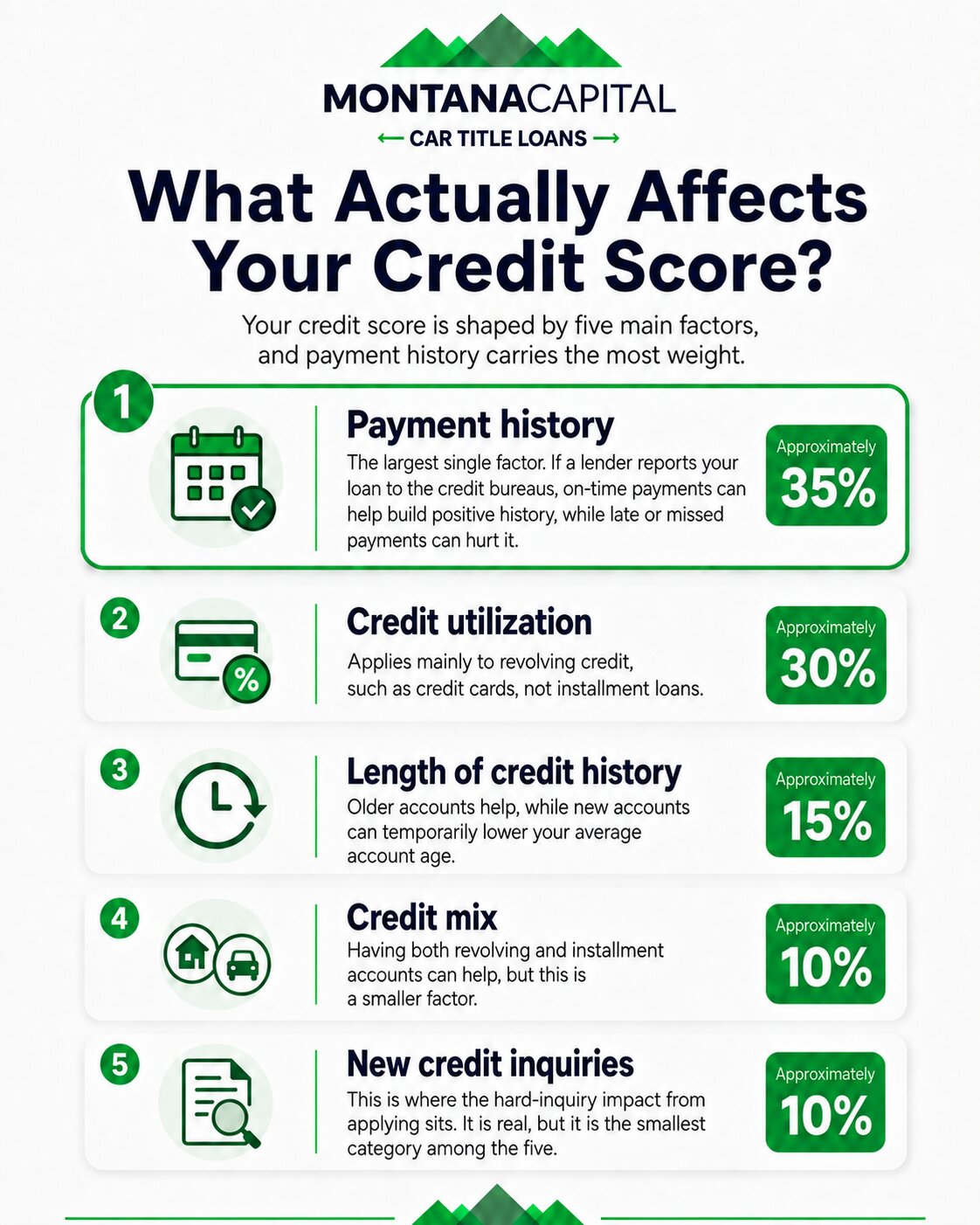
Your credit score is shaped by five main factors, and payment history carries the most weight.
- Payment history makes up approximately 35% of your FICO score and is the largest single factor. If a lender reports your loan to the credit bureaus, making every payment on time can help build a positive payment history, while missed or late payments can damage it.
- Credit utilization accounts for approximately 30% and applies mainly to revolving credit like credit cards, not installment loans.
- Length of credit history accounts for approximately 15%. Older accounts help, and opening new accounts shortens your average account age temporarily.
- Credit mix accounts for approximately 10%. Having both revolving and installment accounts can help, but this is a smaller factor and not worth chasing on its own.
- New credit inquiries account for approximately 10%. This is where the hard-inquiry impact from applying sits. It is real, but it is the smallest category among the five.
Because payment history is worth about 35% of your FICO score, whether a loan is reported at all matters far more than the fact that it is specifically a title loan.
Is a Title Loan the Right Choice If You’re Trying to Build Credit?

If your main goal is building credit, a title loan generally won’t help. But if you need fast cash and credit building is not the goal, the real risk to weigh is cost, not your credit score.
The average title loan interest can be anywhere between 200% to 300% annually. At MontanaCapital®, we offer title loans with rates between 60% and 175% APR, depending on your state. Note that title loans are intended for short-term financial needs only.⁶
Because we don’t report routine payments to the bureaus, a title loan here won’t build your credit history. On-time payments simply won’t appear on your report. That’s different from a product specifically designed for credit building, where every payment you make is working toward a longer, stronger credit history.
Better Options for Building Credit
If your goal is specifically to build credit, these alternatives are generally better suited to that purpose:
- A secured credit card. You deposit a small amount as collateral, use the card for routine purchases, and pay the balance monthly. The payment history is reported and builds your credit over time.
- A credit-builder loan from a credit union. These products are specifically designed to help people establish or repair credit, typically with low balances and structured reporting to the bureaus.
- Nonprofit credit counseling through the NFCC. If debt is the underlying issue, a National Foundation for Credit Counseling member agency can help you build a plan without adding new debt on top of existing obligations.
Learn how title loans are structured, from application through repayment.
3 Questions to Ask Any Title Lender About Credit Reporting
- Do You Report to the Credit Bureaus?
Ask specifically whether the lender reports to TransUnion, Equifax, and Experian, and whether that includes both on-time payments and missed payments. Don’t assume the answer is no.
- What Happens to My Credit If I Miss a Payment?
A lender who doesn’t report routine payments may still report a delinquency or refer a default to collections. Ask what the escalation process looks like and at what point a missed payment could reach your credit report.
- Is the Credit Check a Hard or Soft Inquiry, and When Does It Happen?
A soft inquiry has no impact on your score. A hard inquiry can cause a small, temporary dip. Knowing when in the process the check occurs helps you decide whether to complete the application or shop elsewhere first.
The Bottom Line
Whether a title loan affects your credit depends less on the product and more on the lender and what happens during repayment.
At Montana Capital®, we do not report routine payments to the credit bureaus, so on-time payments won’t build your score, but they also won’t lower it.
Ready to see what you may qualify for? Get started now or call us at 1 888 508-5366.¹
Important: Title loans are expensive and intended for short-term financial needs only. They may involve high fees and interest rates and are not a long-term financial solution. Consider alternatives such as personal loans, credit union loans, or borrowing from family or friends before proceeding.
Frequently Asked Questions
Do title loans go on your credit report?
With Montana Capital®, no, we don’t report your title loan payments to the credit bureaus, so the loan won’t appear on your credit report through routine reporting. But the answer isn’t the same for every lender.
Does a title loan check your credit?
Yes, a credit check can be part of the title loan process.
For us, it isn’t the primary approval factor because vehicle value and verified proof of income carry more weight in our lending decisions.³
Do title loans build credit?
Since we do not report payments to the bureaus, on-time payments simply won’t show up on your credit report, so they won’t contribute to your payment history. If building credit is your goal, a secured credit card or a credit-builder loan from a credit union will do that job more effectively.
Does pawning affect your credit?
A traditional pawn shop transaction, where you leave an item as collateral and reclaim it when you repay, typically doesn’t involve a credit check or credit reporting.
A “title pawn,” however, is a different product that uses your vehicle title as collateral, similar to a title loan, and is regulated differently depending on the state.
What happens to my credit if I default on a title loan?
Defaulting on a title loan and having your vehicle repossessed can result in a collections account on your credit report, even from a lender that never reported a single routine payment.
A collections account may be reported to the credit bureaus and can remain on your credit report for up to seven years.