






A car repair loan isn’t a single product; it’s any loan you use to cover a repair bill. Your main options for financing car repairs are personal loans, title loans, payday loans, and credit cards, each of which works differently.
A car title loan bases approval on your vehicle’s value and your ability to repay, not your credit score. It’s the option we offer directly.
Quick Facts
- Millions of Americans cannot afford their car repairs and need financing to pay for them
- An auto repair loan provides the funds needed to handle important car repairs
- Personal loans, title loans, credit cards, and payday loans are options to finance car repairs
- Check a loan’s interest rate, origination fee and term to choose the find the best loan
- You can get car repair financing for bad credit. Different lenders look at credit, income, and collateral differently.
- Start with an itemized repair estimate so you know how much you genuinely need to borrow.
Editorial Disclosure: Montana Capital Car Title Loans® (NMLS ID 2249848) is a licensed direct lender. This content is informational only and does not offer legal or financial advice. Terms, APRs, and availability may vary by state and borrower qualifications.
If your car needs repairs and you don’t have the cash, you’re in good company.
According to AAA, 64 million Americans cannot afford unexpected car repairs. They state that owning and operating a car costs an average of $8,500 a year, and the average repair can set you back $500-$600 or more. It’s understandable why many car owners need car repair loans to handle the costs.
What is an Auto Repair Loan?
An auto repair loan is a loan with funds you can use for any purpose, such as car repairs. Some options are secured, meaning you provide collateral for the loan. Title loans are secured by your vehicle, so the lender may repossess it if you fail to repay the loan as agreed.
However, some auto repair loans, such as personal loans and credit cards, are unsecured, meaning there is no collateral at risk, though they often have higher interest rates or fees.
In other words, “auto repair loan” describes what you are using the money for rather than one particular loan product. Your options can include a title loan, personal loan, credit card, or financing offered through a repair shop.
Tip: What You Should Be Aware of When Choosing Auto Repair Loans
When choosing an auto repair loan, look closely at its rates, fees, and terms. Select a loan with an affordable monthly payment that will not increase the repair cost excessively, but will provide the funds fast.
Use this title loan calculator to see how different loan options fit your budget.
How Car Repair Financing Typically Works
Car repair costs can range widely, from just a few hundred dollars for minor fixes to several thousand for major engine or transmission repairs.
According to lending platforms, many borrowers seek repair loans between $500 and $5,000, depending on their vehicle and the severity of the issue.
Here’s a quick breakdown of how the financing process usually works:
- Get a Repair Estimate
Start by visiting your mechanic or auto shop to receive a detailed, itemized repair quote. - Determine Your Loan Amount
Calculate how much you need to borrow based on the estimate. Don’t forget to include a small buffer for unexpected costs or taxes. - Compare and review Offers
Compare offers from multiple lenders before applying. Review the APR, fees, loan term, and monthly payment to make sure the loan fits your budget and needs. - Apply for a Loan
Choose a lender offering personal or auto-repair-specific loans. Complete the application, which may require proof of income and a credit check. - Receive the Funds
Once approved, funds are deposited directly into your bank account, sometimes within 1 to 2 business days. - Pay for Repairs & Repay Over Time
Use the funds to pay the mechanic, then begin making fixed monthly payments until the loan is repaid in full.
This process allows you to keep your car running without emptying your emergency savings or delaying essential repairs. Just be sure to compare terms across multiple lenders to find the best rate and avoid hidden fees.
Car Title Loans for Repair Costs
A title loan is approved based on your vehicle’s market value and your ability to repay, meaning whether you can realistically afford the payments, not primarily your credit score.
Eligibility and What We Review
We review your vehicle’s value alongside your ability to repay. A credit check may be part of the review, but it isn’t the main factor. See title loan requirements for the full list.
How the Process Works
The title loan process generally involves a few steps:
1. Complete the online application
Use the online application to check whether you may be pre-approved. It typically takes about five minutes.
2. Complete the vehicle review
In many cases, the vehicle inspection can be completed online, depending on the vehicle’s condition, history, and eligibility. Some applicants may still need to visit a physical location because of state law or their individual circumstances.
3. Provide any required documents
You may receive conditional approval while your documents and other information are being verified. Conditional approval is not the same as final approval.
4. Review and accept the loan terms
If approved, review the loan amount, repayment terms, fees, and other conditions before accepting the loan.
5. Receive your funds
Same-day funding may be available if your application is approved before the daily cutoff. Availability and exact terms vary by state.
Title Loan Risks and Responsible Borrowing
A title loan is secured by your vehicle. If you miss enough payments, the lender can repossess it, meaning take it back, and you may owe towing, storage, and sale-preparation fees on top of what you already owed.
Approval is based mainly on your ability to repay, confirmed through proof of income, with your vehicle as collateral. A credit check is a secondary factor, not the main one.
Title loans are meant for short-term needs, not an ongoing financial solution. Before you sign, ask:
- How much will I repay in total, including fees?
- What happens if I miss a payment?
- Can I pay it off early, and does that reduce what I owe?
See Is a Title Loan Right for You? for more on deciding if this is the right option.
Other Types of Auto Repair Loans
Three other common ways to pay for a repair exist, each with a different credit bar and cost.
Personal Loans
Personal loans for car repair are unsecured and usually come from banks, credit unions, or online lenders. However, most lending institutions require good credit to approve personal loans, so they can be harder to get.
Personal loans are installment loans. This means you repay the loan in equal monthly payments over the loan term. To determine your eligibility, lenders look at your credit history, score, and debt-to-income ratio. The more debts you have, the harder it is to qualify.
Payday Loans
Payday loans are short-term advances of your upcoming pay. Most lenders require full payment on your next payday plus interest, which can be as high as 400%. Most borrowers cannot repay the amount owed in full and end up in a debt cycle with increasing costs each time they renew the loan.
Credit Card
Credit cards may be an option to finance car repairs, but like payday and title loans, use this option cautiously. Credit card interest compounds daily, so your balance increases fast if you only make the minimum payments.
You can finance your repairs without paying interest if you have a credit card with a 0% APR or qualify for one.
Car Repair Loans Compared
| Loan type | Main factors | Funding | Main consideration |
|---|---|---|---|
| Title loan | Vehicle value + ability to repay | Same-day⁷ may be available | Vehicle secures the loan |
| Personal loan | Credit, income, and debts | Varies by lender | No vehicle collateral |
| Payday loan | Income and lender requirements | Often relatively fast | High cost and short repayment period |
| Credit card | Existing credit limit | Immediate if available | Interest if the balance is carried |
How to Compare Auto Repair Loans
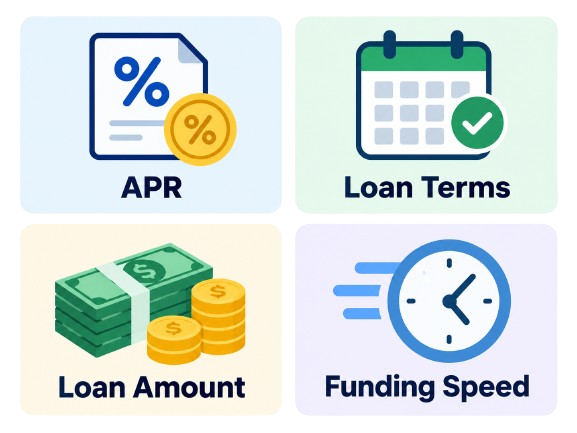
If you need a loan for auto repairs, compare your needs and options to find the right loan.
APR
Some loans have lower APRs than others. Compare the interest charges and origination fees charged on each loan. Next, compare how much interest you’ll pay over the loan term. The lower the APR is, the less the loan costs overall.
Loan Terms
The repayment term refers to how long you have to repay the loan. A longer-term loan offers lower monthly payments.
However, you’ll pay more interest over the life of the loan. A shorter term has higher monthly payments but may cost less overall. Compare the payments to what you can afford to decide.
Maximum Loan Amount
Each loan offers a different loan amount based on your qualifying factors. Determine the cost of the car repairs minus any money you have to cover some of the costs. Compare the amount you need to each loan option available.
Funding Speed
Time is of the essence when borrowing money for an auto repair. Compare the funding times of the loans available to you to get the funds the fastest. Some loans offer same-day funding, helping you get your car back the fastest.
What Do Auto Repair Loans Cover?
Auto repair loans can cover the cost of almost any car repair. Here are some examples:
- Oil changes
- New tires
- Transmission replacement
- A/C repairs
- Repairs to pass emissions
- Repairs after an accident
Once funds are disbursed, lenders typically don’t restrict how you use them. You’re free to pay the shop directly.

FAQ
How Do You Apply for Auto Repair Loans?
Many auto repair loans, such as personal and title loans, allow online applications.
However, you can apply for these loans in person with some lenders if you prefer. Compare funding speed across your options, since that’s often what matters most when a repair can’t wait.
Can You Get an Auto Repair Loan With Bad Credit?
Yes, you can get car repair financing with bad credit. While getting approved for a personal loan with bad credit can be challenging, payday and title loans may place less emphasis on a high credit score.
When comparing the best auto repair loans for bad credit, look at each loan’s total cost, repayment terms, and eligibility requirements before deciding which option fits your situation.
Are There Auto Repair Financing Loans Available?
There aren’t loans specifically meant for auto repairs. However, some auto repair shops may partner with lending institutions to offer customers financing options for auto repairs.
Can a Car That Needs Repairs Still Be Used for a Title Loan?
Possibly. A vehicle does not necessarily have to be in perfect condition to be considered as collateral.
We take the vehicle’s current condition into account when assessing its market value. Damage, mileage, make, model, and overall condition can all affect the car’s value.
Can I Get Car Repair Financing If I’m Self-Employed?
A traditional paycheck is not the only way to show income. Depending on the lender, bank statements, tax returns, or other documents may be used to verify self-employment income.
Final Thoughts
A repair bill you weren’t expecting doesn’t have to derail everything else. If your credit is strong, a personal loan or a 0% APR credit card may cost you less.
If it isn’t, a title loan may be the fastest realistic path, since approval is based on your vehicle’s value and your ability to repay rather than your credit score.
Not sure what you’d qualify for? Use our title loan calculator to see estimated numbers before you apply, or apply now for same-day funding⁷ if approved before the cutoff.