






An emergency home repair can be difficult to cover if you don’t have enough savings, especially if bad credit limits your options.
There are still several ways to pay for urgent repair work. Some people may qualify for government or nonprofit help. Others may need to look at personal lending, secured borrowing, credit cards, or a car title loan.
The best route will depend on how urgent the repair is and what you can realistically qualify for. Lower-cost help may take longer to arrange, while quicker borrowing can cost more or require collateral.
At a Glance
✔ Bad credit doesn’t rule out financing for an emergency home repair. A car title loan and a bad-credit installment loan are both realistic options.
✔ Personal loans, credit cards, and payday loans are also options, though each comes with its own credit bar and cost.
✔ Government and nonprofit home repair programs exist, but usually require homeownership and income qualification, and can involve a wait. They’re worth checking first only if the repair can wait.
✔ A car title loan may be worth comparing if you own a vehicle with enough equity and other borrowing options are limited.
✔ Compare the total cost and repayment terms before choosing any form of finance.
Editorial Disclosure: Montana Capital Car Title Loans® (NMLS ID 2249848) is a licensed direct lender. This content is informational only and does not offer legal or financial advice. Terms, APRs, and availability may vary by state and borrower qualifications.
When a Car Title Loan May Be an Option
A car title loan may be worth comparing when a repair can’t wait, cheaper credit isn’t available, and you own a vehicle with enough equity. Because the loan is secured by your vehicle rather than your home, homeownership isn’t required.
At Montana Capital Car Title Loans®, as a direct lender, we review your application and make the lending decision ourselves. We look mainly at your car’s value and whether you can comfortably make the payments, not your credit score.³
Title loans cost more than most bank or credit union options. They make the most sense for a true emergency, like a repair that can’t wait, when cheaper credit isn’t available to you.⁶
What We Review
We do not run a credit check for pre-approval. If you decide to move forward with a loan, we may review credit reports from TransUnion, Equifax, LexisNexis, or FactorTrust as part of final approval.
Credit is not the main approval factor. We focus primarily on your verifiable income and vehicle equity, and applicants with bad credit are welcome to apply.
See title loan requirements for the full eligibility list, or check what disqualifies an applicant if you’re not sure where you stand.
How the Process Works
- Apply Online, by Phone or in Person. It typically takes about five minutes⁷ and costs nothing to submit. Have your personal details, income information and car details ready, and you’ll see if you’re pre-approved.
- Get Your Offer. Once you qualify, we send you a free offer showing your APR, fees, monthly payment and term. All of it is set according to your state’s law. Then upload your ID, proof of income, car title, and photos of the inside and outside of your car.
- Complete the Vehicle Review. In many cases, this can be done online, though some applicants may still need to visit a location because of state law or their own circumstances.
- Review and Sign. Go over your loan amount, repayment terms, and fees, ask any questions, then sign if you’re ready to move forward.
- Get Funded. Same-day funding⁷ is possible when approved before 2:00 p.m. PT on a business day, though this depends on your state and your documentation.
The Risk to Know
Your vehicle secures the loan. If you fall behind on payments, you risk repossession, meaning the lender can take the car back⁵.
Repossession is a last resort and is handled in accordance with state law. Terms, amounts, and requirements vary by state, so what applies to one borrower may not apply to another.
Example: A $3,000 Repair in California
Say a furnace replacement runs $3,000. In California, where our rate caps at around 39.6% APR for loans in that range, a 24-month title loan works out to about $183 per month, or roughly $4,390 total, including interest, plus the $75 processing fee and $15 title registration fee.
Your numbers will look different depending on your state, loan amount, and term, so use our Title Loan Calculator to see estimated figures for your situation.
We’re licensed to offer title loans in 12 states where permitted by law, so your own rate, range, and term may look different depending on where you live. See Locations to check what applies in yours.
Other Bad-Credit and Assistance Options
A title loan isn’t the only option. Bad-credit installment loans, personal loans, credit cards, payday loans, and government or nonprofit repair programs are all worth knowing about.
Bad-Credit Installment Loans
An installment loan is a loan you repay in fixed monthly payments over a set term. It’s typically unsecured, so there’s no vehicle or home at risk if you fall behind, though missed payments can still hurt your credit and lead to collections.
When comparing home repair loans for bad credit, lenders built for weaker credit often accept scores in the high 500s, though APRs commonly run from around 20% up to 36%, and funding is often the next business day after approval.
Personal Loans
A traditional personal loan works much the same way, but most banks, credit unions, and online lenders want good to fair credit to approve one at a competitive rate.
The weaker your credit, the harder these are to get, and the more they tend to cost when you do.
Credit Cards
A credit card can cover a repair if you already have room on one, and a 0% introductory APR card can cost you little or nothing in interest, as long as you qualify and pay off the balance before the promotion ends. Outside of that, interest compounds daily, so a balance you only make minimum payments on grows fast.
Payday Loans
A payday loan is a short-term advance on your next paycheck, usually due in full on your next payday. APRs on these can run into the hundreds of percent, and most borrowers who can’t repay the full balance end up renewing the loan and paying more each time.
Government and Nonprofit Programs
The USDA’s Section 504 program offers home repair loans up to $40,000 and grants up to $10,000 for homeowners who occupy the property, meet income limits, and live in an eligible rural area. Grants are reserved for homeowners age 62 and older.
Approval depends on funding availability in your area, so there’s no guarantee it comes through before a repair needs to be done. Local housing agencies sometimes run similar programs worth a call.
| Option | Credit/Eligibility Needed | Funding Speed | Best For |
|---|---|---|---|
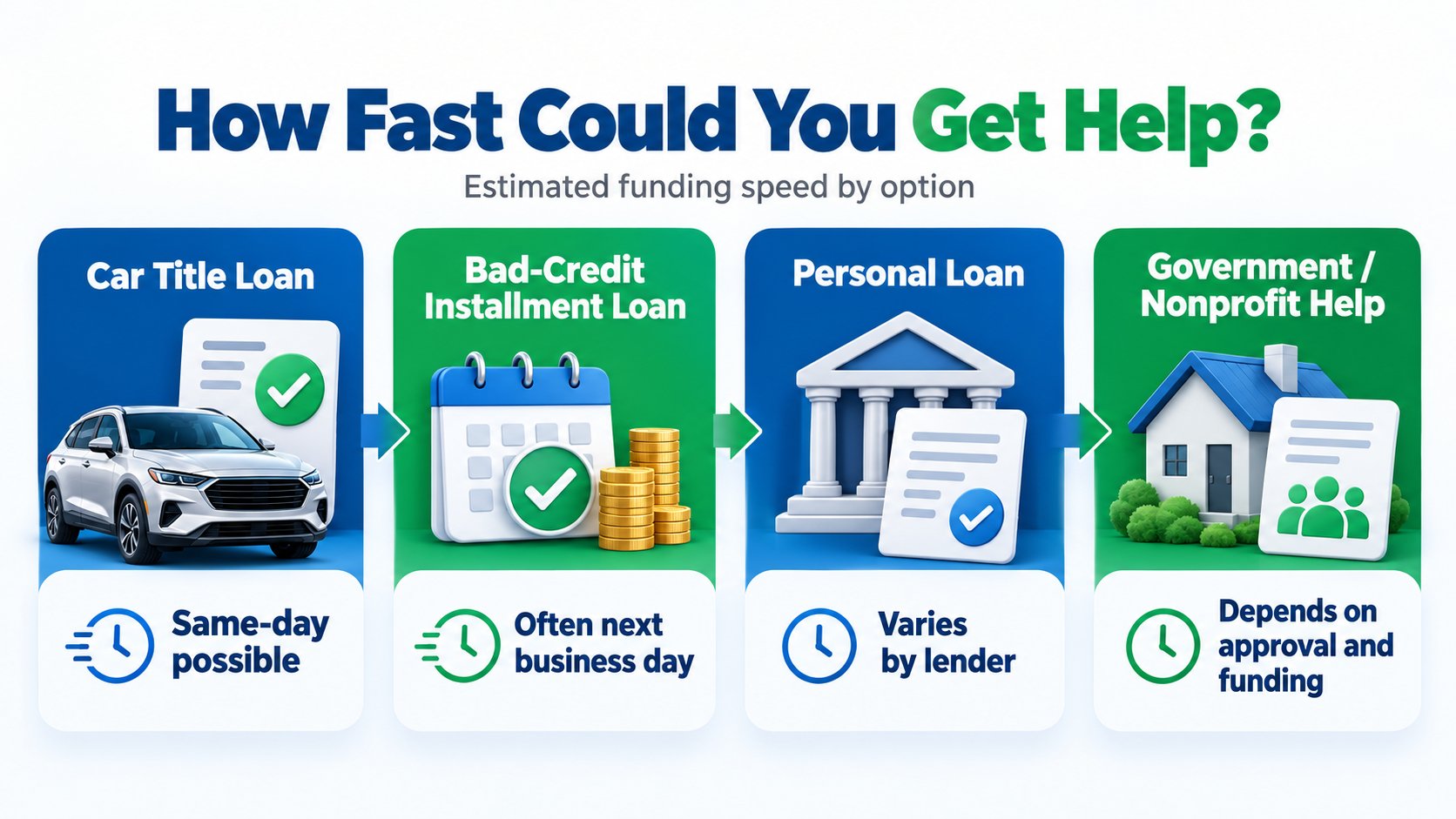
| Car Title Loan | Vehicle value + ability to repay | Same-day⁷ possible | Needing cash within days |
| Bad-Credit Installment Loan | Credit score around 550+ | Often the next business day | Slightly better credit, still urgent |
| Personal Loan | Good to fair credit | Varies by lender | Stronger credit, lower overall cost |
| Credit Card | Existing credit limit | Immediate if available | Smaller repairs, 0% APR offers |
| Payday Loan | Income and lender requirements | Often the same day | Short-term only, very high cost |
| USDA Section 504 | Homeownership + income limits | Depends on funding availability | Repairs that can wait |
If your repair can wait and you own your home, it’s worth checking the USDA or a local housing agency first. If it can’t, and weaker credit is standing in the way of a bank loan or a 0% card, a car title loan is worth comparing, since your credit score isn’t the deciding factor.
Before You Borrow for a Home Repair
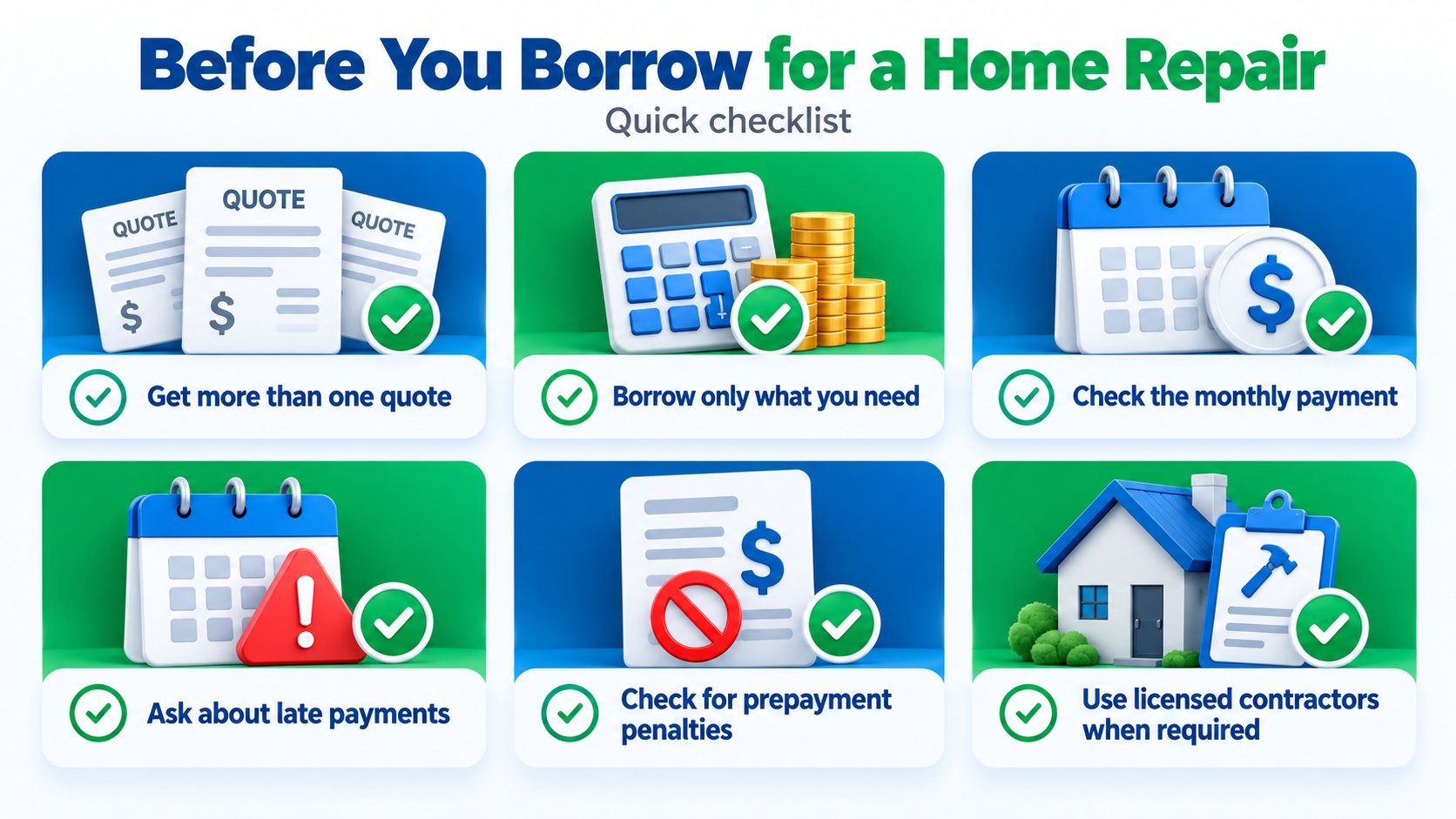
If your timeline allows it, get more than one repair quote before you borrow. Contractors can quote very differently for the same job, and that gap often matters more than the loan you pick.
Borrow only what the repair actually costs, plus a small buffer for anything the contractor finds once the work starts. A bigger loan than you need just means more to repay.
Before you sign anything, ask yourself honestly whether you can keep up with the payments through your next pay cycle or for as long as the loan runs.
See how title loans are paid back for what a typical repayment schedule looks like, and ask the lender what happens if a payment is late before you commit, not after.
If you do take out a title loan and later want to pay it off faster, check whether it carries a prepayment penalty. Ours doesn’t, so clearing it early never costs extra.
One more tip, separate from financing: gas, electrical, and structural repairs usually need a licensed contractor, no matter how you pay for them. That’s a safety requirement, not a lending one, and it’s worth factoring into your repair quote either way.
FAQ
Do I Need to Own My Home to Get a Title Loan?
No. A car title loan isn’t tied to owning your home at all, since your vehicle is what secures it, not the property. That’s different from USDA or local housing agency repair programs, which generally require homeownership.
Renters and homeowners can both apply, as long as the vehicle and application meet title loan requirements.
How Much Can I Borrow for Emergency Home Repairs?
Personal loans, credit cards, installment loans, government programs, and title loans all have different borrowing limits and qualification requirements.
With a car title loan, the amount available depends mainly on your vehicle’s value, your available equity, your ability to repay, and state law. Montana Capital title loans generally range from $500 to $50,000, although the minimum and maximum can vary by state.
What Counts as an Emergency Home Repair?
Most urgent household repairs qualify: a broken furnace or AC, a leaking roof, plumbing failures, electrical issues, and storm or water damage are common ones.
Once your loan is funded, how you spend it is largely up to you, so you pay the contractor or supplier directly for whichever repair is most pressing.
Does Getting Pre-Approved Hurt My Credit Score?
No. Seeing whether you’re pre-approved won’t affect your credit score, so you can find out where you stand before you decide anything.
If you choose to move forward, we may review your credit reports as part of final approval. Even then, your score isn’t the main thing we look at. Your car’s value and your ability to make the payments matter more.
Can I Get a Title Loan If My Car Isn’t Fully Paid Off?
Possibly. We typically need a lien-free title in your name, or one that’s nearly paid off, since the loan amount depends on your available equity in the vehicle.
If you still owe a meaningful balance, it’s worth asking us what equity you have before you apply.
Choosing the Right Option for an Urgent Repair
An urgent home repair can limit your options, especially if your credit makes traditional borrowing harder. The right choice depends on how quickly you need the money, what you qualify for, and what the overall financing will cost.
If the repair can wait, it may be worth checking personal loans, available credit, or government and nonprofit assistance first.
If those options aren’t available and you own a qualifying vehicle, a car title loan is another option to compare. Because your vehicle secures the loan, make sure you’re comfortable with the repayment terms before going ahead.
A car title loan gives you a path that doesn’t depend on your credit score, with same-day funding⁷ possible if you’re approved before the cutoff.
We’re seeing more borrowers come to us because they have an urgent household expense they can’t put off. Home repairs are one example, particularly when traditional credit isn’t available to them.
Not sure what you’d qualify for?